

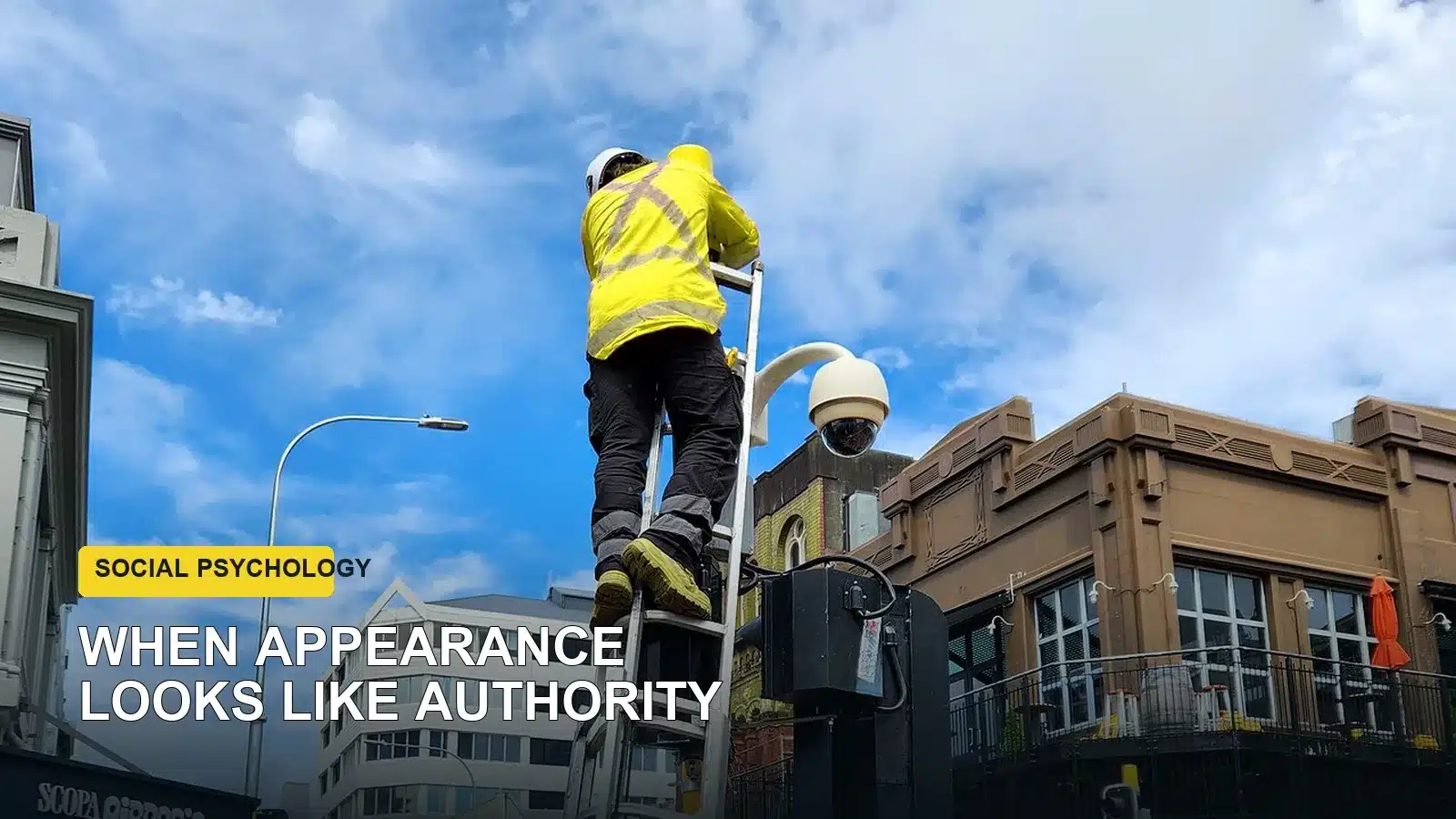
Have you ever imagined that a simple appearance could make you seem like you belong somewhere, even without anyone asking you to prove it?
A simple disguise that changed how people reacted
In a social experiment—a clip of which went viral online—a group of young people set out to test a psychological concept based on acting confidently, as if their presence in a given place were perfectly natural.
The young people wore yellow vests similar to those worn by maintenance and construction workers, carried a wooden ladder on their shoulders, and then moved confidently through various locations.
According to the experiment’s findings, few people stopped them, because their appearance and behavior made their presence seem to others as if it were related to work or a maintenance task.
In this way, they were able to gain access to places such as movie theaters, amusement parks, and museums; they also managed to bypass some security checkpoints at stadiums and other venues without purchasing tickets.
Why appearances can override verification
The point the experiment sought to demonstrate is that people sometimes rely on snap judgments rather than actually verifying the facts; when someone appears to belong there and acts confidently, others may automatically assume they have a legitimate reason for being there.
This reaction is often explained through authority cues and role expectations. A high-visibility vest, a ladder, a clipboard, or a confident tone can signal “worker” before anyone pauses to verify an identity. Classic social-psychology research has also shown that uniforms can increase compliance, although one viral video cannot establish a universal rule about human behavior.
What the experiment does—and does not—prove
However, the findings of this experiment do not mean that wearing a yellow jacket and carrying a ladder grants anyone the right to enter restricted areas, and bypassing entry systems or checkpoints without authorization may lead to legal or security consequences.
Nevertheless, the experiment remains noteworthy because it reveals the extent to which appearance and confident behavior influence the way people judge those around them.
Editorial context: Viral retellings appear to combine more than one online stunt. Troy Kinne uploaded Can You Get in Anywhere With a Ladder? in June 2015. Yes Theory uploaded Sneaking in EVERYWHERE for FREE (Yellow Vest Experiment) in November 2017; its own introduction named movie theaters, a restaurant kitchen, a museum, the Los Angeles Zoo, and an amusement park. The latter video shows high-visibility vests and inspection props, while the supplied graphic shows a metal ladder rather than a wooden one. These were entertainment videos, not controlled scientific studies, and Yes Theory explicitly warned viewers not to replicate the behavior.
The practical lesson: verify the role, not just the look
The safest takeaway is not that a disguise always works. It is that people and organizations should avoid treating familiar clothing or confident behavior as proof of authorization. A polite identity check, a work order, a visitor badge, or confirmation with a supervisor can prevent a visual shortcut from becoming a security failure.
Frequently asked questions
What was the yellow vest social experiment?
It was a viral entertainment video in which creators wore high-visibility workwear and acted like inspectors while attempting to enter venues without ordinary admission. Their footage suggested that familiar work cues sometimes reduced scrutiny.
Did a yellow vest and ladder guarantee entry?
No. The videos showed selected attempts, including moments when staff questioned or stopped the participants. They do not prove that the tactic works everywhere or that clothing alone caused each outcome.
Was this a scientific psychology experiment?
No. It was a filmed social stunt rather than a controlled study with a defined sample, comparison group, or peer-reviewed method. It can illustrate a question about authority cues and snap judgments, but it should not be treated as scientific proof.
Is it legal to copy the stunt?
Entering paid or restricted spaces without permission can lead to removal and possible legal or security consequences. The original creators also warned viewers not to imitate them.
A final thought
The story is memorable because the props were ordinary. That is precisely why the lesson matters: when something looks familiar, people may stop asking whether it is genuine. The better habit is simple—respectfully verify before granting access.
Sources: Yes Theory’s 2017 video, Troy Kinne’s 2015 ladder video, and Leonard Bickman’s study, “The Social Power of a Uniform”.
