

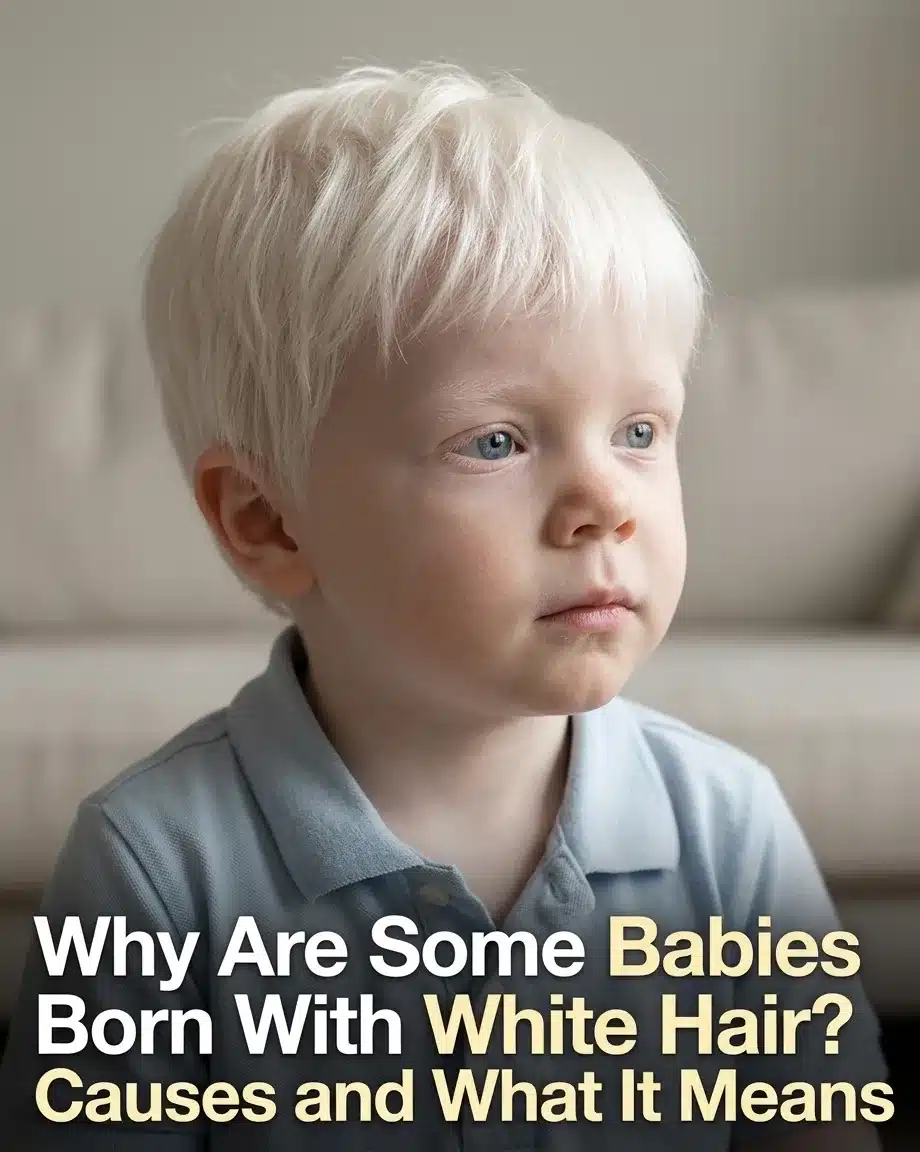
Why Are Some Babies Born With White Hair? Causes Explained…
Have you ever scrolled through social media and stopped dead in your tracks because of a single photo? A few years ago, that exact thing happened to millions of people when images of a newborn named Bence started circulating. He wasn’t notable for his weight or his dimples. What caught everyone’s eye was his full head of striking, snow-white hair.
Naturally, the comment sections exploded. People wondered if the photo was photoshopped, if the baby was an albino, or if something was wrong with his health.
While seeing an infant with silver or snow-white locks feels like something straight out of a fantasy novel, it is a real biological phenomenon. If you are curious about what actually causes a baby to be born with white hair, let’s peel back the layers of biology, genetics, and folklore to find out what’s really going on.
The Chemistry of Hair: How Color Actually Happens
To understand why a baby’s hair might lack color, we first need to look at how hair gets its shade in the first place.
It all comes down to a pigment called melanin. Inside every hair follicle on your scalp, tiny cellular factories called melanocytes work around the clock to pump pigment into the growing hair shaft.
Human hair relies on two primary types of melanin:
-
Eumelanin: Responsible for dark shades like black and brown.
-
Pheomelanin: Responsible for reddish and light blonde tones.
When a baby enters the world with white hair, it simply means those melanocyte factories weren’t producing pigment while the hair was forming in the womb. The hair shaft itself is transparent, but it appears bright white because of how light bounces off the hollow structure.
Why Are Some Babies Born With White Hair? The Main Causes
When doctors examine a infant born with snow-white hair, they generally look at three main possibilities.
1. Delayed Pigment Production (The “Baby Bence” Case)
Believe it or not, the most common reason isn’t a disease at all. Sometimes, a baby’s pigment cells are just late to the party.
In the case of Baby Bence—the viral sensation mentioned earlier—doctors running tests discovered he did not have albinism. Instead, his body experienced a temporary delay in melanin production. As these infants grow, their melanocytes usually wake up, and their hair naturally darkens into blonde, light brown, or darker shades over time.
2. Oculocutaneous Albinism
Albinism is a group of genetic conditions where the body lacks the enzyme needed to produce melanin altogether.
If albinism is the root cause, the white hair is usually permanent. Babies with this condition typically have extremely pale skin, blue or grey eyes, and a higher sensitivity to sunlight and bright room lights.
3. Poliosis and Genetic Variations
Sometimes a baby isn’t born with an entire head of white hair, but rather a single white streak or patch near the forehead. This condition is called poliosis.
It happens when a small cluster of hair follicles lacks pigment cells. While often just a unique family trait passed down through generations, poliosis can occasionally be tied to underlying genetic variations like Waardenburg Syndrome.
Is White Hair in Newborns Dangerous?
It’s completely natural for parents to feel anxious when their baby looks vastly different from expected norms. However, the white hair itself is harmless—it is just keratin without dye.
The primary concerns come down to protective care:
-
Sun Sensitivity: Melanin acts as a natural shield against ultraviolet rays. A baby with white hair (and pale skin) lacks this barrier, making careful sun protection essential.
-
Eye Care: Because melanin plays a crucial role in developing the retina, babies with albinism require early eye examinations to ensure their vision develops smoothly.
Final Thoughts
Seeing a baby born with white hair is a vivid reminder of how complex and unpredictable human genetics can be. Whether it turns out to be a temporary delay in pigment or a permanent condition like albinism, it is a fascinating natural trait that makes every child uniquely who they are.
Frequently Asked Questions
Why are some babies born with white hair?
Babies are born with white hair due to a lack of melanin production in their hair follicles. Common causes include temporary pigment delays, albinism, or localized conditions like poliosis.
Will a baby’s white hair stay white forever?
Not always. If the cause is a temporary pigment lag, the hair usually darkens as the baby grows. If the cause is a genetic condition like albinism, the hair typically remains white or light blonde.
Does maternal stress cause a newborn to have white hair?
No, maternal stress during pregnancy does not turn a baby’s hair white. Fetal hair pigmentation is controlled entirely by genetics and cellular development in the womb.
