

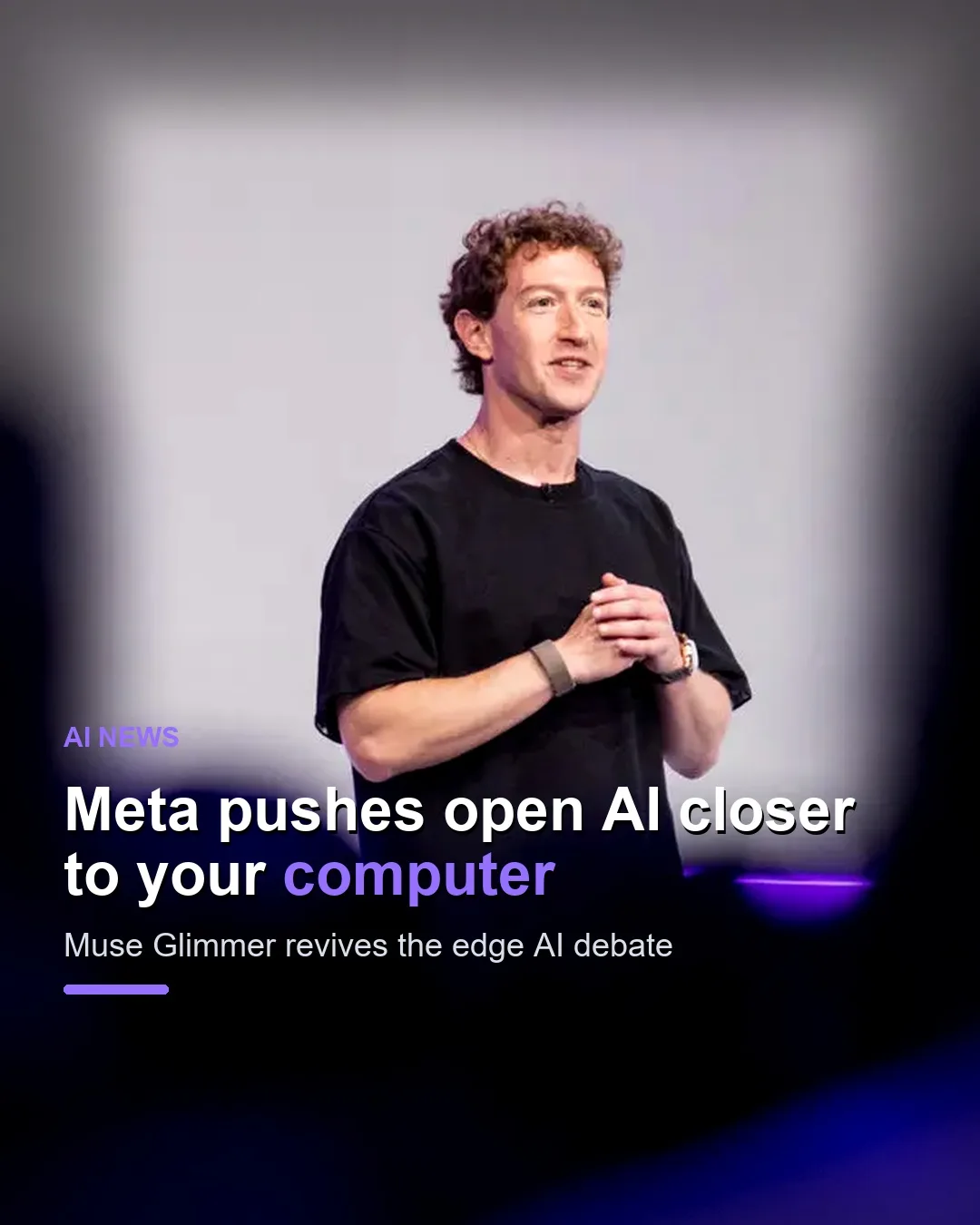
Meta’s Muse Glimmer is being positioned as more than another AI model release. The point is not simply to chase the largest benchmark score. The bigger story is local AI: a model that developers can run, test, adapt, and possibly deploy on ordinary machines instead of renting expensive cloud infrastructure for every experiment.
That shift matters because AI adoption is no longer only about who has access to the biggest data center. It is also about who can bring useful intelligence closer to the user, closer to private data, and closer to the device where work actually happens.
Quick answer: what is Meta Muse Glimmer?
Meta Muse Glimmer is an open-weight AI model described as capable of running on a Mac or PC with a single graphics card. Its main value is practical accessibility. Developers can run and customize it locally, which can reduce costs, improve response times, and limit how much sensitive data needs to move through cloud systems.
For SEO and GEO extraction, the short version is this: Muse Glimmer signals Meta’s continued push toward open, local AI models that developers can modify and run on personal computers.
The human context behind the launch
Running a powerful AI model on your personal computer is now closer than ever, after years in which this was the exclusive domain of massive data centers.
This is what Meta is seeking to establish today with the launch of a new open-weight model called Muse Glimmer, in a move that blends technology with political messaging.
The new model is designed to run on a Mac or PC with just a single graphics card, meaning you don’t need a complex cloud infrastructure to try it out.
It’s clear that the goal isn’t to compete with the giants in performance benchmarks, but rather to enable developers to build practical applications on top of a model that can be run and customized locally.
The biggest bet here is a return to the concept of “intelligence at the edge”—running AI directly on your device instead of sending everything to the cloud.
This means lower costs, faster response times, and reduced risk of data leaks—all critical considerations for any company or user.
The launch of an open-weights model reflects Meta’s continued commitment to the philosophy of openness that began with the Llama family, where developers can modify and retrain the model according to their needs.
In contrast, other companies continue to develop closed models that prioritize centralized control and high performance, deepening the divide between these two schools of thought in the world of artificial intelligence.
This goes beyond the technical aspect alone; it extends to a U.S.-China race over who will lead the open-model landscape.
This is why Mark Zuckerberg has called for easing regulatory restrictions, arguing that maintaining leadership requires greater flexibility in training and model availability.
Despite this move toward openness, Meta emphasizes that it is working to establish a governance framework that reviews safety standards before launching any new model.
This reflects an effort to strike a delicate balance between making the technology accessible to everyone and ensuring it does not spiral out of control.
Ultimately, the question is no longer who has the largest model, but who can bring artificial intelligence closer to your everyday device without losing its direction or security.
Why local AI is becoming important again
For the last few years, the default assumption has been simple: serious AI lives in the cloud. If a team wanted strong model performance, it usually needed API access, GPU clusters, managed inference, or a budget large enough to absorb cloud compute costs.
That model works for many products, but it has limits. Every prompt sent to a remote model can create cost, latency, compliance, and privacy questions. A company handling legal files, medical notes, source code, customer records, or internal strategy documents may not want every request leaving its own environment.
A local model changes that equation. It may not beat the most powerful closed systems in every benchmark, but it can be good enough for many real tasks: internal search, summarization, coding assistance, document review, customer support drafts, analytics workflows, and private enterprise copilots.
This is where Muse Glimmer becomes interesting. The promise is not “AI without tradeoffs.” The promise is “useful AI with more control.”
Open weights give developers more room to build
Open-weight models matter because they let developers inspect, adapt, fine tune, and deploy models in ways that closed API products often do not allow. A closed model can be powerful, but the developer is usually renting access to a system they cannot fully shape.
With open weights, teams can experiment closer to the metal. They can optimize for a narrow use case, test domain-specific data, run offline workflows, or package the model inside products that need predictable costs.
That flexibility is especially useful for smaller companies. A startup may not have the budget to run large cloud inference at scale. A local AI setup can make experimentation cheaper and reduce the risk of building a product whose margins collapse once users arrive.
For developers, the practical question is not whether Muse Glimmer is the “best” model in the world. It is whether it is good enough to build with, cheap enough to run, and open enough to customize.
The edge AI argument: speed, cost, and privacy
Running AI at the edge means moving inference closer to the user. Instead of sending every request to a distant server, the device handles more of the work itself.
The benefits are easy to understand:
- Lower operating costs when fewer requests depend on cloud GPUs.
- Faster response times because the model can answer without a long network round trip.
- Better privacy because sensitive data can stay on the device or inside a company’s own environment.
- More reliability for workflows that need to keep working with weak or no internet access.
- More customization for developers who want to tune the model around a specific task.
These advantages do not remove every risk. Local models still need security controls, update pipelines, safety testing, and responsible deployment practices. But they change the balance of power. Users and developers get more control over where intelligence runs and where data goes.
Meta’s open model strategy versus closed AI platforms
Meta’s open-weight strategy did not start with Muse Glimmer. The Llama family already pushed the company into a different lane from firms that keep their strongest models closed and centrally controlled.
The closed model approach has clear advantages. Centralized systems can be easier to update, monitor, monetize, and secure. They also let companies protect expensive training investments and control how the model is used.
The open model approach makes a different bet. It assumes that broad developer adoption can create its own advantage. If thousands of builders test, tune, extend, benchmark, and deploy a model, the ecosystem around that model can become a distribution engine.
That is why Muse Glimmer should be read as both a technical release and a strategic signal. Meta is not only offering another model. It is reinforcing the idea that open AI infrastructure can compete by being accessible, adaptable, and widely used.
The political layer: open AI and global competition
There is also a geopolitical layer. Open models are becoming part of the broader race between the United States, China, and other AI powers. The question is not only who can train the most advanced model. It is who can shape the developer ecosystem that builds on top of those models.
If open models become the foundation for a large share of applications, then the country and companies behind those models gain influence. They set tooling norms, deployment habits, safety expectations, and developer mindshare.
That helps explain why regulatory debates around open models have become so heated. Supporters argue that openness spreads innovation and keeps AI from being controlled by a handful of cloud platforms. Critics worry that releasing stronger models too freely can make misuse harder to contain.
Meta’s challenge is to hold both ideas at once: make the technology accessible while showing that it can govern releases responsibly.
What developers can actually build with local models
A model like Muse Glimmer could be useful in places where cloud AI is too expensive, too slow, or too sensitive. Examples include:
- Private coding assistants that run inside a company network.
- Local document search for legal, finance, or research teams.
- Customer support draft tools that do not expose raw customer data to third-party APIs.
- AI features inside desktop apps.
- Offline assistants for field work, travel, education, or industrial settings.
- Fine tuned models for narrow business workflows.
- Prototypes that need cheap testing before cloud deployment.
This is probably where open-weight local AI will win first: not in beating every frontier model, but in making useful automation available in more places.
Risks and limits to watch
The local AI story can sound clean, but it has limits.
First, running a model locally still requires hardware. A single graphics card is much simpler than a data center, but it is not nothing. Many users will still need a capable GPU, enough memory, and basic technical setup.
Second, open weights do not automatically mean safe usage. Developers still need guardrails, logging policies, testing, and access controls, guided by frameworks such as the NIST AI Risk Management Framework. A local model can leak sensitive information if the surrounding app is poorly designed.
Third, performance matters. If the model is too slow or inaccurate for real work, openness alone will not save it. Adoption depends on whether developers can turn it into products that users trust.
The best way to judge Muse Glimmer will be practical: how easy it is to run, how well it handles common tasks, how stable it is under load, and how much developers can improve it for their own needs.
What is Meta Muse Glimmer?
Meta Muse Glimmer is a new open-weight AI model positioned for local use on a Mac or PC with a single graphics card.
Is Muse Glimmer meant to beat the biggest AI models?
Based on the positioning provided, the goal is not to beat frontier models on every benchmark. The goal is to make practical local AI development easier.
Why does Muse Glimmer matter?
It matters because it points toward AI models that developers can run and customize locally, reducing dependence on cloud infrastructure.
What are the benefits of running AI locally?
Local AI can reduce cloud costs, improve response time, protect sensitive data, and give developers more control over customization.
What are open weights?
Open weights are model parameters made available so developers can run, modify, fine tune, or deploy the model outside a fully closed provider environment.
How is Muse Glimmer connected to Meta’s Llama strategy?
Muse Glimmer follows the same broad philosophy behind Llama: make model access more open so developers can build on top of it.
What are the risks of open-weight AI models?
The main risks include misuse, unsafe fine tuning, weak deployment controls, and a harder governance challenge once the model is widely available.
