

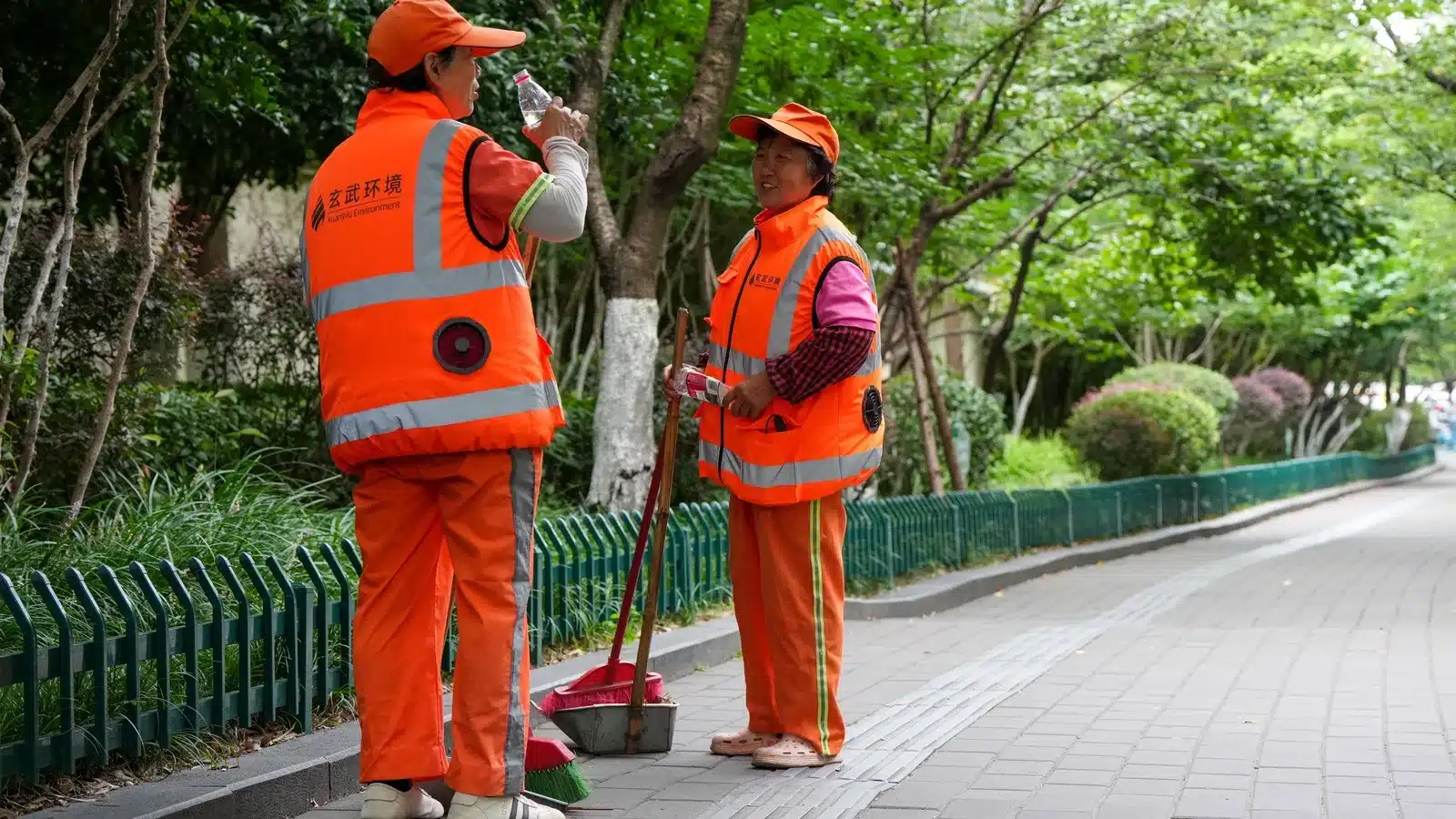
Quick answer: In July 2026, sanitation workers in Nanjing’s Xuanwu District began testing reflective vests fitted with two small electric fans. The fans draw outside air into the vest, have three speed settings, and run for three to four hours on a portable power bank. The system moves air rather than refrigerating it.
As temperatures rise during the summer, street cleaners in China have begun using vests equipped with electric fans, designed to help them endure long hours of work in extremely hot conditions.
The reported program is a local pilot, not a nationwide rollout. According to CCTV News reporting republished by Xinhua, more than 20 vests were issued to workers on selected routes in Nanjing’s Xuanwu District before the hottest part of summer.
How the fan-equipped cooling vests work
These vests contain small built-in electric fans that continuously circulate air beneath the clothing and around the worker’s body while they are outdoors.
The vests retain the bright fabric and reflective strips of standard sanitation uniforms. Two quiet fans sit at the waist, one on each side. They pull air into the lining, where it travels upward around the back, arms, and neck.
The fans are powered by portable batteries and, according to reports, can operate for several hours at a time.
The source reporting is more specific: a full charge powers the fans for three to four hours. Workers can recharge the power bank during their midday break, and the three speed settings let them adjust the airflow.
The idea is simple, but it can be very helpful when working in temperatures exceeding 40 degrees Celsius; the movement of air helps sweat evaporate more quickly, which can make a big difference for people performing physically demanding work outdoors.
Important context: Nanjing’s heat rules require all outdoor manual work to stop when temperatures exceed 40 degrees Celsius. The vests are an added cooling measure for permitted work in hot weather, not a reason to keep sanitation workers outside above that limit.
The Nanjing sanitation-worker pilot
These vests have been used by sanitation workers in Nanjing, where the summer heat can be extremely harsh on people who spend their entire workday outdoors.
One of the first workers to test the equipment was 57-year-old Zhu Wenxian on Jiming Temple Road. He told reporters that sweat used to soak his back during a morning shift. With both fans running, he felt air rise from his waist toward his neck and said his clothes stayed much drier.
Nanjing Daily reporting carried by Sina said the first batch included more than 20 vests. The Nanjing Urban Management Bureau was recommending the pilot to other districts after favorable early feedback.
Why the name “air-conditioned vest” is misleading
Although sometimes described as “air-conditioned” jackets, they do not function like traditional air conditioners that actually cool the air.
However, they provide workers with a constant flow of air around their bodies and under their clothes while they clean the streets, helping them cope better with the heat.
The Chinese nickname translates roughly as “air-conditioned vest,” but there is no compressor or refrigerated air. The cooling comes from air movement and faster sweat evaporation. That distinction matters because the effect depends on conditions, clothing fit, airflow, and the worker’s ability to sweat.
Cooling gear is only one part of heat protection
The vest pilot sits alongside wider heat-safety measures. Nanjing adjusts schedules, increases mechanized cleaning, provides rest stations with air conditioning and water, and limits outdoor work as temperatures climb. Local rules cited by Nanjing Daily stop manual outdoor work above 40 degrees Celsius and limit total exposure between 37 and 40 degrees.
As extreme heat becomes an increasing problem in cities around the world, even a simple piece of technology like this can help make outdoor work safer and more sustainable.
Sometimes a smart idea doesn’t have to be complicated.
It’s enough to make hard work just a little less grueling.
The fans may make a shift more tolerable, but they do not replace shade, water, rest breaks, schedule changes, medical monitoring, or firm temperature limits.
Frequently asked questions
Where are Chinese street cleaners using fan-equipped vests?
The reported 2026 pilot took place in Xuanwu District, Nanjing, Jiangsu Province. More than 20 vests were distributed to workers on selected routes, including Jiming Temple Road.
How long do the vest fans run?
Reports say a fully charged portable power bank runs the fans for three to four hours. Workers can recharge during their midday break.
Do the vests actually air-condition the air?
No. They do not refrigerate the air. Two small fans move outside air through the vest and help sweat evaporate, which can lower the wearer’s perceived temperature.
How many fans are built into each vest?
Each vest has two small fans positioned at the waist, one on each side. The system offers three airflow settings.
Do Nanjing street cleaners work outdoors above 40 degrees Celsius?
Nanjing’s stated rules require outdoor manual work to stop when temperatures exceed 40 degrees Celsius. The cooling vests support workers during permitted hot-weather shifts; they do not override that safety rule.
Source note: The main operational details come from CCTV News, Nanjing Daily, the Nanjing Urban Management Bureau, and a July 28, 2026 Xinhua photo report. Image reuse rights should be confirmed before manual publication.
