

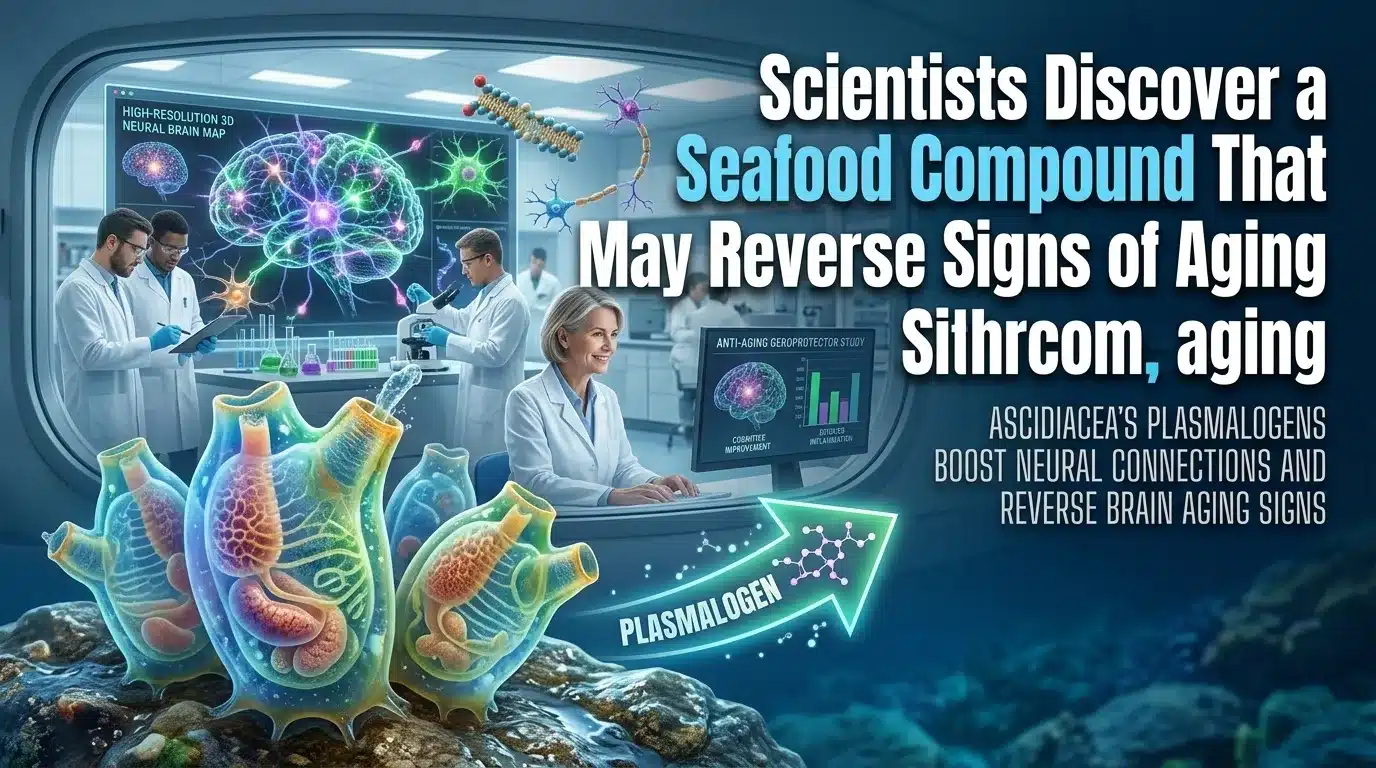
A seafood compound for aging is attracting attention after scientists discovered promising effects in older mice. The research suggests that plasmalogens may help improve memory, reduce brain inflammation, and influence other signs associated with aging.
What if one of the most unexpected clues to healthier aging came from the ocean?
Scientists are taking a closer look at a naturally occurring compound found in an unusual type of seafood called sea squirts. In experiments involving older mice, researchers found that compounds known as plasmalogens were associated with improvements in memory and learning, healthier connections between brain cells, lower brain inflammation, and even changes in the animals’ hair.
The findings have attracted attention because they suggest that some biological changes associated with aging may not be completely irreversible.
However, there is an important distinction: the research was conducted in mice, not humans. The results are promising, but they do not currently prove that eating sea squirts or taking plasmalogen supplements can reverse aging in people.
So, what exactly did scientists discover, and why are plasmalogens attracting so much attention?
How Does This Seafood Compound for Aging Work?
The compound at the center of the research is called plasmalogen.
Plasmalogens are a special type of lipid, or fat molecule, that naturally occurs throughout the human body. They are particularly abundant in important organs and tissues, including the brain, heart, and immune cells.
Scientists have observed that plasmalogen levels tend to decrease as people age. Lower levels have also been observed in connection with certain neurodegenerative diseases, including Alzheimer’s disease and Parkinson’s disease.
This has raised an interesting scientific question: could restoring plasmalogens help protect the aging brain?
Sea squirts, marine animals belonging to the group Ascidiacea, are one natural source of these compounds. They are consumed as food in parts of Asia, including Korea and Japan.
Researchers therefore became interested in investigating whether increasing plasmalogen intake could influence some of the biological changes associated with aging.
What Are Sea Squirts?
Sea squirts may not be the first food that comes to mind when people think about seafood.
These marine animals attach themselves to underwater surfaces and are eaten in several Asian cuisines. In Korea, sea squirts are commonly known as meongge, while in Japan they are known as hoya.
What makes them particularly interesting to researchers is their relatively high concentration of plasmalogens.
Rather than suggesting that sea squirts are a magical anti-aging food, scientists are interested in understanding the biological compounds they contain and how those compounds may interact with the body.
That distinction is important because the potential benefits observed in laboratory experiments cannot automatically be applied to human diets.
How Did Scientists Study the Effects of Plasmalogens?
To investigate the potential effects of plasmalogens, researchers gave plasmalogen supplements to aging mice and compared them with older mice that did not receive the supplementation.
The scientists then examined several aspects of aging, including learning, memory, brain structure, inflammation, and physical changes.
One of the key tests involved the Morris water maze, a commonly used laboratory test for studying learning and memory in mice.
The animals had to learn the location of a hidden platform. Younger mice generally learn the location more efficiently, while aging can make the task more difficult.
After several days of training, the older mice receiving plasmalogens performed significantly better than untreated aged mice.
According to the researchers, their performance became more similar to that of younger animals.
Plasmalogens and Memory: What Did Researchers Find?
One of the most interesting findings involved memory and learning.
Aging can be associated with changes in the brain’s ability to form and maintain connections between nerve cells. These connections, known as synapses, play a central role in communication between neurons.
Researchers examining the brains of the mice found that animals receiving plasmalogens had more synapses, and those synapses appeared to be in better condition than those in untreated aged mice.
This could help explain the improvements observed during the learning experiments.
The findings suggest that plasmalogens may influence processes involved in maintaining the brain’s communication networks.
But again, this does not mean that plasmalogen supplements have been proven to improve memory or reverse cognitive aging in humans.
Human clinical research would be necessary before making that conclusion.
Could This Seafood Compound Help the Aging Brain?
The brain appears to be one of the most important areas affected in the research.
Scientists believe that plasmalogens may influence several biological mechanisms involved in brain aging.
One possibility is their role in supporting the structure of cell membranes. Because synapses depend on healthy and flexible membranes to communicate efficiently, changes in membrane composition could potentially influence how neurons exchange signals.
The researchers also found evidence suggesting that plasmalogens may increase molecules involved in the growth and development of neurons and synapses.
This raises the possibility that plasmalogens could support a process known as neuroregeneration.
Neuroregeneration refers broadly to the repair, renewal, or growth of nerve cells and their connections.
If future research confirms these effects, it could become an important area of study in the search for ways to maintain brain health during aging.
Brain Inflammation May Also Play a Role
Another important finding involved inflammation.
Inflammation is a normal part of the body’s immune response. However, persistent or excessive inflammation can become harmful, including in the aging brain.
In the experiment, mice receiving plasmalogens showed substantially lower levels of brain inflammation compared with untreated aged mice.
Researchers believe that this reduction could be connected to the improvements in learning and memory observed in the treated animals.
The relationship between inflammation, aging, and brain function is complex, though. Scientists are still working to understand exactly how these processes interact.
The new findings provide another reason to investigate whether plasmalogens could influence multiple aspects of brain aging rather than affecting only one biological pathway.
The Gut-Brain Connection Could Be Important
Scientists are also considering another possible explanation: the gut-brain axis.
The gut contains a huge community of microorganisms known collectively as the gut microbiome. Increasing research suggests that communication between the gut and brain can influence immune activity, metabolism, and neurological processes.
According to the researchers, dietary plasmalogens may influence microorganisms in the gut.
This means that some of the observed effects might not come exclusively from direct action inside the brain. Changes in the gut microbiome and the signals it sends to the brain could potentially contribute to the results.
The gut-brain connection is an active area of scientific research, and much remains to be discovered about how diet, microorganisms, inflammation, and brain aging interact.
One of the Most Surprising Findings: Darker Hair
The brain-related results were not the only unusual observation.
Researchers also reported visible changes in the hair of aging mice that received plasmalogens.
The treated mice developed new hair that was described as thicker, darker, and glossier compared with untreated aged mice.
This finding is particularly interesting because changes in hair pigmentation and thickness are among the visible signs commonly associated with aging.
However, it is important not to interpret this as evidence that plasmalogens can reverse gray hair in humans.
The observation occurred in an animal experiment, and researchers would need controlled human studies to determine whether anything similar happens in people.
Does This Mean Seafood Can Reverse Aging in Humans?
Not yet.
This is probably the most important point to understand about the research.
The experiment produced promising results in aged mice, but mice and humans are not biologically identical. A compound that produces an effect in an animal model may not necessarily produce the same effect in humans.
Researchers still need to determine whether plasmalogens can produce comparable benefits in people, what amounts would be effective, and whether long-term supplementation is safe.
For that reason, the discovery should be viewed as an interesting scientific development rather than a proven anti-aging treatment.
The research provides a potential direction for future studies, but it does not establish that humans can reverse aging by eating a particular seafood or taking a supplement.
Why Are Scientists Interested in Plasmalogens?
The growing interest in plasmalogens comes from their connection to several important biological processes.
These molecules are naturally present in cell membranes and are especially concentrated in tissues such as the brain.
Because plasmalogen levels tend to decrease with age, scientists have become interested in understanding whether that decline is simply a consequence of aging or whether it may contribute to some age-related changes.
If restoring plasmalogen levels can protect cells, support synapses, reduce harmful inflammation, or encourage regeneration, the compounds could become an important subject for future aging research.
The current findings add to that scientific interest by showing several effects at the same time in an animal model.
What Could This Mean for Future Anti-Aging Research?
The research could have implications beyond seafood itself.
Scientists are increasingly interested in finding ways to maintain brain function as people grow older. Instead of focusing only on visible signs of aging, researchers are investigating cellular health, inflammation, metabolism, synaptic function, and the ability of tissues to repair themselves.
Plasmalogens fit into this broader area of research because they are connected to cell membranes and brain function.
Future studies could investigate whether naturally occurring plasmalogens, purified compounds, or other methods of restoring plasmalogen levels could have measurable effects in humans.
Researchers may also investigate whether plasmalogens interact with other biological pathways involved in aging.
Should You Start Taking Plasmalogen Supplements?
The current evidence does not provide enough information to recommend plasmalogen supplements as an anti-aging treatment.
The reported experiment was conducted in mice, and important questions about human effectiveness, appropriate dosage, and long-term safety remain unanswered.
People should therefore be cautious about treating preliminary animal research as proof of a health benefit in humans.
The discovery is best understood as a promising research finding rather than a confirmed solution for aging.
The Bigger Picture
Aging is not controlled by a single molecule or biological process.
It involves many interconnected changes affecting cells, tissues, the immune system, metabolism, the brain, and other systems throughout the body.
That is why discoveries involving individual compounds are valuable even when they are still at an early stage.
The research on plasmalogens does not show that scientists have found a way to make humans younger. Instead, it provides evidence that some changes associated with aging may be biologically modifiable, at least in an animal model.
That idea could be significant for future research.
Final Thoughts
The discovery of a potential seafood compound for aging is certainly unusual, but the science behind it is more interesting than the headline alone suggests.
Researchers found that plasmalogen supplementation was associated with better learning and memory, healthier synapses, reduced brain inflammation, and darker, thicker hair in aging mice.
These results raise important questions about whether restoring plasmalogens could eventually help protect the aging brain or influence other age-related changes.
But there is still a long road between promising results in mice and a proven treatment for humans.
For now, the discovery gives scientists another fascinating direction to explore in the study of healthy aging, brain regeneration, and age-related cognitive decline.
The ocean may have provided an unexpected clue—but researchers still need to determine whether that clue can eventually translate into meaningful benefits for people.
The findings were reported by ScienceDaily based on research from scientists studying the effects of plasmalogens in aging mice.sciencedaily.com
