

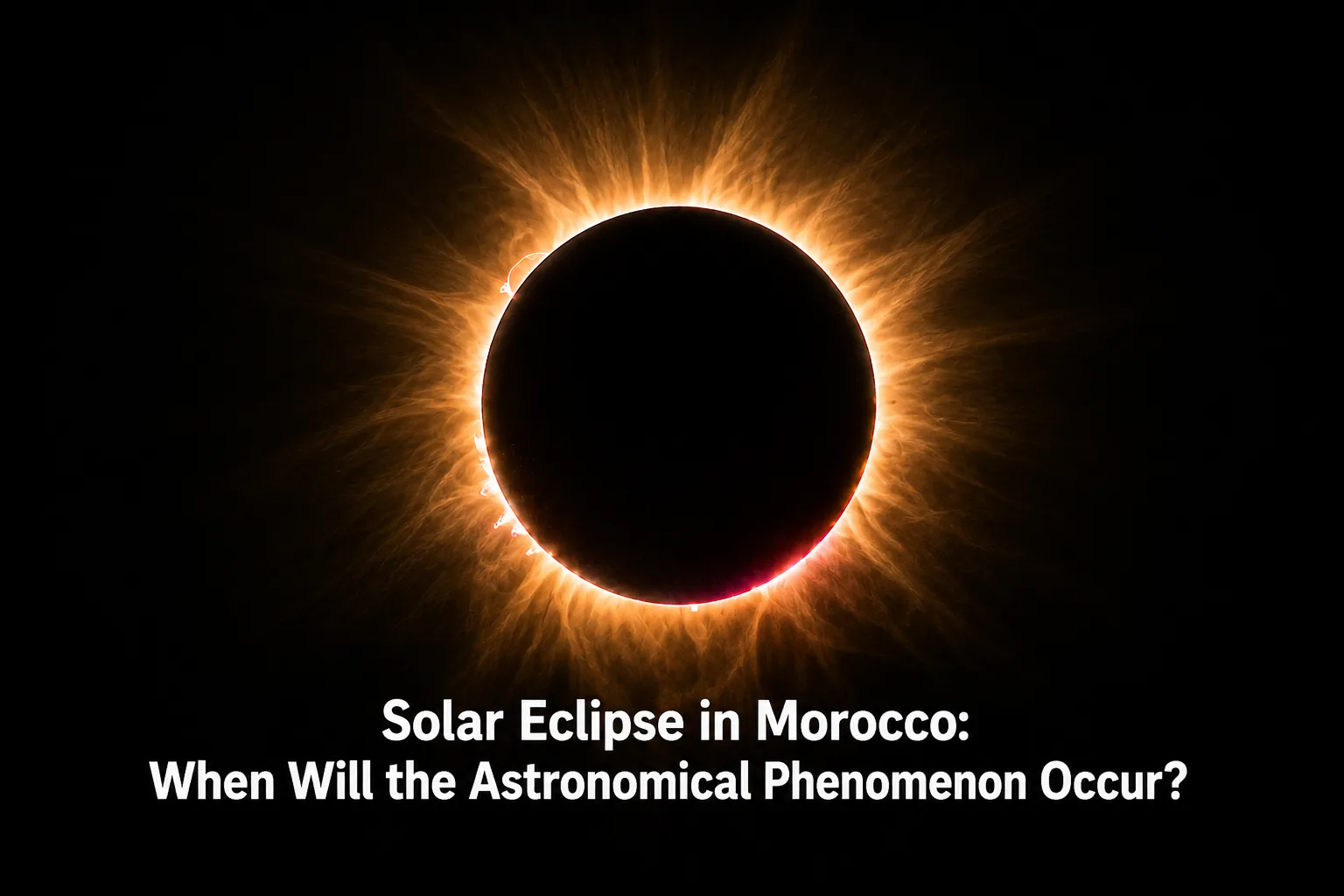
Today, Wednesday, August 12, the world is witnessing an exceptional astronomical event: a total solar eclipse, which will appear in Morocco as a partial eclipse, with up to approximately 93 percent of the Sun obscured in northern regions, according to Professor Zuhair Benkhaldoun of Al-Qadi Ayyad University and director of the Oukaimden Astronomical Observatory, Zouhair Ben Khaldoun.
In a statement to the Moroccan News Agency, Ben Khaldoun explained that August 12 will see a total solar eclipse, noting that this phenomenon occurs when the Sun, the Moon, and the Earth align in a straight line.
He added that when a perfect alignment occurs in a specific region of the globe, the Moon’s disk can completely obscure the Sun’s disk, causing a total eclipse. He explained that the path of totality will pass primarily over the North Pole, Greenland, Iceland, and a small part of Portugal, and to a greater extent over Spain, before ending over the Mediterranean Sea.
The director of the Oukaimden Astronomical Observatory confirmed that in Morocco, the eclipse will be partial because the kingdom lies outside the path of the total eclipse and within the moon’s penumbra, noting that “for Morocco, the eclipse will be partial, with a coverage ranging from about 93 percent in the north to 60 percent in Dakhla.”
He added that Nador will be the city with the highest percentage of coverage, at about 92.9 percent, followed by Tangier, Tetouan, and Al Hoceima at around 92 percent, while the percentage will be about 89.5 percent in Fez, 88 percent in Rabat, 87 percent in Casablanca, 83 percent in Marrakesh, 79 percent in Agadir, 70 percent in Laayoune, and 60 percent in Dakhla.
He added that, in general, the eclipse in Morocco will begin between 6:44 p.m. and 7:06 p.m., depending on the region, and will reach its peak between 7:40 p.m. and 8:00 p.m., with the phenomenon ending between approximately 7:58 p.m. and 8:39 p.m.
In explaining the difference between the regions affected by the total eclipse and those that will experience a partial eclipse, Ben Khaldoun noted that the Moon casts a shadow on Earth consisting of a central region called the “umbra,” and another region called the “penumbra.” He explained that the eclipse will be total within the umbra, while it will be partial within the penumbra, which includes Morocco.
